Friday, July 4, 2014

Healthcare Leaders to Chart Out Blueprint of Healthcare Reforms at India Leadership Conclave 2014

Healthcare Leaders to Chart Out Blueprint of Healthcare Reforms at India Leadership Conclave 2014

Veteran Healthcare Leaders Dr B Somraju, Dr Mukesh Batra, Dr Shashank R Joshi, Dr. Gaurav Sharma, Dr Jothydev Kesavadev, Dr. Sandeep Chatrath, Dr. Ashwini Kumar Kudari among others to debate Unequal India & an unfinished agenda  of the Indian Healthcare Challenges


More than Half the population of India who live in the remotest corners of the country are not equal partners of the rest of india with regard to Healthcare access, insurance, affordability & above all the impending critical diseases where healthcare is denied & marginalized due to the poor economic conditions & the failure of the successive governments at the centre to provide the healthcare access & treatment. Healthcare in India is both a complex challenge and an immense opportunity. Beyond the health benefits of medical innovations and interventions, addressing access to affordable basic health and wellness care is imperative to the financial security of low-income Indians. Indeed, health expenses remain the leading reason for India’s growth trajectory. on-communicable diseases (i.e. Diabetes, Heart Disease, and Cancer), Health Financing, Maternal/Infant Medicine remain the bigger challenges in India reflecting the current epidemiology in India’s poor state of Healthcare reforms. Historically, it was communicable diseases, such as Tuberculosis and Polio, which received the attention of public health experts as these globally afflict the poor. NCDs, such as diabetes and hypertension, were not prioritized as these were considered ‘lifestyle diseases’ that only affect wealthy populations. In fact, there are 63 million diabetic patients in India, and rural and urban poor account for over 60% of cases. Lack of access to affordable care makes NCDs more prevalent among poor Indians.
For those who cant afford in private hospitals, the rosy picture of India’s rising space in healthcare domain is a non issue despite the claim that the healthcare sector in India is expected to grow at a CAGR of 15 per cent to touch US$ 158.2 billion in 2017 from US$ 78.6 billion in 2012, & india being a country with a growing population, its per capita healthcare expenditure has increased at a CAGR of 10.3 per cent from US$ 43.1 in 2008 to US$ 57.9 in 2011, and going forward it is expected to reach US$ 88.7 by 2015. It is true that The e factors behind the growth of the sector are rising incomes, easier access to high-quality healthcare facilities and greater awareness of personal health and hygiene.
Healthcare providers in India are expected to spend US$ 1.08 billion on IT products and services in 2014, a four per cent increase over 2013. But why the Doctors are not willing to go out to the villages while assigned to them & Why the Govt is not so serious of revamping the present situation where we have a big requirement of Doctors, Nurses & Primary Healthcare Centres. It is pity that some of the PHC’s in india are either closed or opened for nothing as there are no infrastructure says Mr.Satya Brahma, Chairman & Editor-In-Chief of Network & Media Group on the eve of the debate on “Unequal India & an unfinished agenda  of the Indian Healthcare Challenges” at the 5th Annual India Leadership Conclave & Indian Affairs Business Leadership Awards 2014. The Conclave attempts to find out the opinions of the Healthcare Professionals who will assemble on Friday, 18th July 2014 in Mumbai to debate on this important topic”. Dr. B Somaraju,Cardiologist & CMD, Care Hospitals Group Dr. Mukesh Batra, Founder Chairman, Dr Batra’s Dr Shashank R Joshi ,Endocrinologist & Dibetologist, Joshi Clinic Dr Sandeep Chatrath,CEO,Dharamshila Hospital and Research Centre,Dr Gaurav Sharma,Diabetologist & Life Style Doctor,CMD,DrG Wellness(P)Ltd. Dr. Ashwini Kumar Kudari,Associate Professor, Surgical Gastroenterology MS Ramaiah Medical College, Bangalore Dr.Jothydev Kesavadev,Founder Chairman, Jothydev’s Diabetes Research Centre And Hospitals, Dr Chytra.V.Anand, Cometic Dermatologist of Kosmoderma & Dr Deepak K Jumani, Consultant in Sexual Health and Counsellor. The Conclave is running on a theme “Perform or Perish”

Indian Challenges
India is here to stay as a stable marketplace with vanishing boundaries and as the most enduring democracy in South Asia. It is not that the party is entirely out of place. In more than six decades of national independence, India has emerged as a reassuring example of freedom in a region otherwise known for less evolved civil societies; India has also bucked the post-colonial trend of the hero of liberation turning into a cult of autocracy. Here come the party poopers, armed with arguments mined from the twilight zones of freedom. The timing of the spoilers' entry is perfect: The cheerleaders of India Ascending, all growth fanatics, are too optimistic to be dispirited by the occasional fall of the rupee or the momentary slowdown of the economy.
AN UNFINISHED AGENDA
The record of India's achievements is not easy to dismiss, but is that the whole story? An agreeable picture of a country in a rapid march forward towards development with justice would definitely not be a comprehensive, or even a balanced, account of what has been actually happening: indeed far from it. There are many major shortcomings and breakdowns-some of them gigantic-even though privileged groups, and especially the celebratory media, are often inclined to overlook them. We also have to recognize with clarity that the neglect-or minimizing-of these problems in public reasoning is tremendously costly, since democratic rectification depends crucially on public understanding and widespread discussion of the serious problems that have to be addressed.
So what is the way out of the health crisis which is perhaps the biggest adversity facing India today? The problems are large, but rather than being overwhelmed by their enormity, we should identify the ways and means of overcoming this adversity, drawing both on the analyses of the factors that have contributed to this crisis, and also-closely related to that investigation-on the lessons that have emerged from the experiences of other developing countries which have dealt with these problems much better than India has. There is also much to learn from the better performance of those Indian states (Kerala and Tamil Nadu in particular) which have taken care of the health of the people a lot better than the rest of India. As far as the rest of the world is concerned, the countries that offer immediate lessons for India include-most importantly-China, but also Brazil, Mexico and Thailand, among others.
A boy receiving polio drops
There has to be renewed focus on primary health centres and village-level health worker.Perhaps the first-and the most crucial-thing to appreciate is the importance of the commitment to universal coverage for all in a comprehensive vision of health care for the country as a whole. Thailand, Brazil and Mexico have got there in recent years, and transformed the reach of health care for their people. China's experience is particularly interesting, since it attempted, first, to deny the necessity of this commitment when the economic reforms first occurred, in 1979, and by reversing the earlier universalism, China paid a heavy price for this denial in terms of the progress of longevity and general health. China eventually realized the error in this denial and, from 2004, started moving rapidly back to universal commitment (China is already 95 per cent there), reaping as it is sowing. And contrary to what we often hear from alleged admirers of China who want India to follow China without being quite sure of what it is that the Chinese do, China does not leave the coverage of health in the hands of private health insurance-the state is the major player to ensure this. These experiences are, as we have already discussed, entirely in line with what we would expect on grounds of economic reasoning, particularly because of (1) the 'public goods' character of the health of people, (2) the role of asymmetric information, and (3) the impact of inequality on the achievement of general health in a community and a nation.
The commitment to universal health coverage would require a major transformation in Indian health care in at least two respects. The first is to stop believing, against all empirical evidence, that India's transition from poor health to good health could be easily achieved through private health care and insurance. This recognition does not, of course, imply that there is no role at all for the private sector in health care. Most health care systems in the world do leave room for private provision in one way or another, and there is no compelling reason for India to dispense with it. Nor can health planning in India ignore the accountability issues and other challenges that affect the operation of the public sector-including the public provision of health care. Nevertheless, the overarching objective of ensuring access to health services and other requirements of good health 'to all members of the community irrespective of their ability to pay' (as the Bhore Committee aptly stated the core principle of universal health coverage many years ago) is intrinsically a public responsibility. Further, given the limitations of market arrangements and of private insurance in the field of health care, public provision of health services has an important foundational role to play in the realization of universal health coverage.

Following on this, the second respect in which the proposed approach demands a change in India lies in the need to go 'back to basics' as far as public provision of health care services-both of a preventive and curative kind-is concerned, with a renewed focus on primary health centres, village level health workers, preventive health measures, and other means of ensuring timely health care on a regular basis. While RSBY (the newly established scheme of subsidized health insurance for poor households) is a humane programme and much better than leaving the poor to die or suffer from neglected health care and unaffordable intervention, better results can be achieved at far less cost through early and regular health care for all (supplemented by providing expensive intervention if and when it is needed despite early and more systematic medical care for all).
The need for public involvement is particularly strong in a range of activities aimed at preventing rather than curing disease, such as immunization, sanitation, public hygiene, waste disposal, disease surveillance, vector control, health education, food safety regulation, and so on (what is technically known as 'public health').
The inaugural years of nation-building, though, were an exercise in Sovietisation with a dash of tentative capitalism; Nehru's New Man of Scientific Temperament was sustained by a socialist regime that spent all its resources on creating a mammoth public sector. It took more than four decades and the courage of a few men in power for India to break out of the comfort zone of socialism and stop looking at the world through the prism of Cold War. The late awakening and an accelerated growth rate, an aspirational middle class and an ambitious entrepreneurial class-the familiar India Stagnant has been replaced by India Rising, as if the world was waiting for the dawn of this democratic counterpoint to the Chinese superpower. It is this velvet narrative of inevitable glory that Nobel Laureate Amartya Sen and his disciple Jean Dreze, two finest minds in development economics, debunk in An Uncertain Glory: India and Its Contradictions, a mandatory reading for every Indian politician in power.
Healthcare Challenges in India
India is among the five countries that spends the least on public health. Overall, we spend a meager four percent of our GDP on health. Out of pocket (uninsured) expenses, meanwhile, account for 70 percent of healthcare expenditure. As a result, families are often choked with medical debt and sink into poverty. And this is affecting India’s growth.
The Innovation of Healthcare in India
Healthcare in India is at a crossroads. On the one hand, it's never been rosier. According to the World Health Organization, India has made significant strides over the past 50 years by improving life expectancy from 42 years to 65 years, reducing infant mortality by two-thirds, and eradicating small pox and polio. Yet on the other hand, the rising incidence of chronic illnesses such as diabetes, hypertension, and cardiac disease will eventually overwhelm a system that is already hampered with limitations in accessibility, affordability, and awareness.
The elephant in the room is the wealth disparity that is clearly evident in the Indian healthcare system. Those in the lower socioeconomic strata are confined to underfunded public facilities and insufficient medical providers, whereas those with the ability to pay have the chance to enter world-class centers of care that offer cutting-edge technology and super-specialists at their beck and call. Interestingly, the summation of all of these factors makes the current climate in healthcare a fertile area for both entrepreneurs and investors.
The answer to India's crisis in healthcare cannot be addressed by simply throwing more money at the problem. The process will need decentralized care, physician extenders, and greater involvement of consumers in their own self-care. Technology will need to be leveraged in each area to create solutions that will improve quality and service without driving up cost. We are already seeing the early promise of telemedicine extending the specialist's reach, vision-screening vans facilitating efficient rural outreach, and the early nibbling of electronic medical records. Future innovations will come from tapping into the one object that straddles individuals of all socioeconomic backgrounds - a cell phone. Understanding the potential of using SMS and mobile health apps can help us find actionable information to manage individual and population health.
Advice for Entrepreneurs
The best opportunities for entrepreneurs in healthcare should:
1) Revolve around solving a problem worth solving - meaning fix something that is a big deal which affects everyone and is a "must have" to all providers and not just a tiny irritant for a few.
2) Incorporate what has worked successfully in other similar countries and learn from what has failed there as well.
3) Gather the best and brightest as you lay the foundations of your team.
One of our biggest healthcare initiatives is to empower consumers to be active participants in their own healthcare. It is time for them to challenge the status quo around diagnostic testing, treatment decisions, and the need for certain procedures. Our belief is that technology can create platforms that will add a layer of objectivity to a very subjective practice. By enabling consumers to become more aware and informed, we allow them to be partners in the process. Over time, this will lead to a paradigm shift that will prioritize wellness and prevention. India will need to move forward in this uphill march against the entrenched cultural roots of the medical system in order to catch up with the momentum in the developed world.
Here are five major healthcare challenges for the next government, including the grim statistics that nearly every election manifesto has conveniently ignored:

1.    Anaemia
Facts: Over half the women in India are anaemic. They have unusually low levels of haemoglobin, which makes it difficult for the blood to clot and increases the risk of postpartum hemorrhage (excessive bleeding) during childbirth. Studies show that anaemia is responsible for 40 percent of maternal deaths in India. And that’s only the women; the World Bank estimates that nearly 70 percent of the children in the country are also anaemic.
Why:  Although some kinds of anaemia can result from infection, most cases of the disease in the developing world are the result of poor nutrition, especially deficiency in iron. Tablets and injections that supplement iron are cheap and accessible, but diagnosis remains a challenge because most poor women and children never get tested for anaemia.
2.Maternal Mortality
Facts:  Each year, 56,000 women in India die due to complications arising from pregnancy or childbirth. According to data released by the Registrar General last year, India’s Maternal Mortality Ratio (MMR) — the number of women who die during pregnancy and childbirth per 100,000 live births — has dropped from 212 to 178 between 2007 and 2012. However, the regional disparities are huge. States such as Tamil Nadu and Kerala, with an MMR of 105, have fared better than poorer states such as Bihar, Uttar Pradesh, Madhya Pradesh, and Chhattisgarh, whose MMR is still over 250. The country as a whole is far behind the Millenium Development Goal of 103. The number of women dying in childbirth is fewer than before, but it still kills more than 150 women everyday.
Why: Too many women in India, who are poor and often anaemic, give birth at home. Many of them are stunted or too thin, which puts them at a higher risk for complications. With no access to sufficient nutrition, antenatal care or even decent hospitals, they succumb to the complications.

3.    Under-Five Mortality
Facts:  According to a 2012 report by the UNICEF, 1.7 million children under the age of 5 die in India every year. Diarrhea — yes, loose bowel movements — alone kills 98,000 children under the age of 5 years. In 2011, India, along with four other countries (Democratic Republic of Congo, China, Pakistan and Nigeria) accounted for half the global deaths of children under five. Alone, it accounted for nearly a quarter of the deaths. The causes include pneumonia, malaria, HIV and measles, but a majority of them died within a month of being born because of complications arising from their birth.
Why:  The biggest reason, according to the UNICEF study, is poor nutrition. Poor education, lack of breastfeeding and maternal mortality drive up child deaths, especially in the immediate weeks following the birth – when they are most vulnerable to weakness and infection.
4.Visual Impairment
Facts: Research organizations such as The Brien Holden Institute in Australia estimate that 456 million people in India need vision correction to help them see clearly. Of those, 133 million, including 11 million children, are blind or visually impaired only because they don’t have access to an eye examination and a pair of glasses.
Why:  For the latter group, the biggest reason is lack of access to an eye test — a room where a trained optometrist can measure their refractive error and write them a prescription for glasses.
5.Cervical Cancer
Facts: A report in 2013 by the US-based Cervical Cancer Free Coalition said that 72,000 women in India die from cervical cancer every year. That’s more than a quarter of the global toll. It’s also the most common cancer among women in India.
Why: The disease, which is sexually contracted, carries a fierce taboo. In addition to that, access to a pap smear test (a reliable cervical cancer screening), and subsequent treatment, is hard to come by in rural India where access to gynaecologists is limited.
A 2009 study says that most of India’s 27 regional cancer centers don’t have gynecological oncologists on staff, and that they don’t reach enough women anyway. Another study from 2013 depicts the sorry state of community health centers, with 70 percent of spots for specialists such as surgeons, paediatricians, gynaecologists lying vacant.
lack of health insurance and its low penetration causes further challenge towards access to healthcare. With 75 percent of the Indian population paying for healthcare services from their own pockets, it puts tremendous financial burden. The Indian healthcare system is a dilapidated state. The costs seem to raise everyday which makes it unaffordable for a large chuck of the population
According to Aman Gupta, “India is the second most populous country in the world and with an healthcare infrastructure that is over-burdened with this ever increasing population, a set of challenges that are unique to India arise.” He explains below:

·         “India faces the twin epidemic of continuing/emerging infectious diseases as well as chronic degenerative diseases.
·         The former is related to poor implementation of the public health programs, and the latter to demographic transition with increase in life expectancy.
·         Economic deprivation in a large segment of population results in poor access to health care.
·         Poor educational status leads to non-utilisation of scanty health services and increase in avoidable risk factors.
·         India faces high burden of disease because of lack of environmental sanitation and safe drinking water, under-nutrition, poor living conditions, and limited access to preventive and curative health services.
·         Lack of education, gender inequality and explosive growth of population contribute to increasing burden of disease.
·         Expenditure on health by the Government continues to be low. It is not viewed as an investment but rather as a dead loss.
·         States under financial constraints cut expenditure on health.
·         Growth in national income by itself is not enough, if the benefits do not manifest themselves in the form of more food, better access to health and education.”

The points that were highlighted in the discussion between IHP and PhRMa were crucial to make healthcare affordable. These are the main points that were discussed, says Aman.

Innovation in healthcare can, partnership amongst pharmaceutical companies (Generic and Research driven), Government of India, NGOs and other stakeholders will be key to this critical role towards ‘Access to Healthcare’.

Innovative business models need to be explored to tackle issues which are very specific to India. These could be PPP, social entrepreneurship or patient assistance programs, etc.

Rapidly ageing population requires affordable, accessible and quality public health services and innovation will key role in meeting these needs.”

But like all plans there are hurdles that slow down the process; these are the speed bumps for India suggests Aman Gupta. “Lack of awareness is a problem which is faced in building access to healthcare. Mass awareness is important since even if the treatment is free, unless the masses are educated and informed about the symptoms of the diseases, its repercussions and complications and finally the treatment available; there is no guarantee that people will avail these.”

“Besides this, lack of health insurance and its low penetration causes further challenge towards access to healthcare. With 75 percent of the Indian population paying for healthcare services from their own pockets, it puts tremendous financial burden.”

Positive India
India being a country with growing population, country's per capita healthcare expenditure has increased at a CAGR of 10.3% from $43.1 in 2008 to $57.9 in 2011 and going forward this figure is expected to rise to $88.7 by 2015.The factors behind the growth is rising incomes, easier access to high-quality healthcare facilities and greater awareness of personal health and hygiene, the report said.The country's healthcare system is developing rapidly and it continues to expand its coverage, services and spending in both the public as well as private sectors, it said.

The private sector has emerged as a vibrant force in India's healthcare industry, lending it both national and international repute. Private sector's share in healthcare delivery is expected to increase from 66% in 2005 to 81% by 2015. Private sector's share in hospitals and hospital beds is estimated at 74% and 40%, respectively.There is substantial demand for high-quality and speciality healthcare services in tier-II and tier-III cities. To encourage the private sector to establish hospitals in these cities, government has relaxed the taxes on these hospitals for the first 5 years.
Many healthcare players such as Fortis and Manipal Group are entering management contracts to provide an additional revenue stream to hospitals.Over the years, health insurance is gaining momentum in India; gross healthcare insurance premium is expanding at a CAGR of 39% over FY06-10. This trend is likely to continue, benefitting the country's healthcare industry
Strong mobile technology infrastructure and launch of 4G is expected to drive mobile health initiatives in the country. Mobile health industry in India is expected to reach $0.6 billion by 2017, the report said.To standardise the quality of service delivery, control cost and enhance patient engagement, healthcare providers are focussing on the technological aspect of healthcare delivery.Digital health knowledge resources, electronic medical record, mobile healthcare, hospital information system are some of the technologies gaining acceptance in the sector. Going forward, the healthcare sector's spending on IT products and services is expected to rise from $53 billion in 2012 to $57 billion in 2013.
Telemedicine is also a fastemerging sector in India. In 2012, the telemedicine market in India was valued at $7.5 million, and is expected to rise at a CAGR of 20% to $18.7 million by 2017. With increased private participation, the healthcare sector has also witnessed rise in FDI inflows. As per law, 100% FDI is permitted for all health-related services under the automatic route.Demand growth, cost advantages and policy support were instrumental in attracting FDI inflows into the healthcare sector. During April 2000-March 2013, FDI inflows for drugs and pharmaceuticals stood at $10.3 billion, while inflows into hospitals and diagnostic centres, and medical appliances stood at $1.6 billion and $0.6 billion, respectively.India's primary competitive advantage over its peers lies in its large pool of well-trained medical professionals in the country. Also India's cost advantage compared to peers in Asia and Western countries is significant — cost of surgery in India is one-tenth of that in the US or Western Europe.India's competitive advantage also lies in increased success rate of Indian companies in getting Abbreviated New Drug Application ( ANDA) approvals. India also offers vast opportunities in R&D as well as medical tourism, the report said.


Saturday, June 21, 2014

Lok Satta Founder President Dr.Jayaprakash Narayan to address at 5th Annual India Leadership Conclave 2014


Lok Satta Founder President Dr.Jayaprakash Narayan to address at 5th Annual India Leadership Conclave 2014

Eminent Public Figure Dr.Jayaprakash Narayan ( JP) to debate “Governance, Democratic Reforms & Economic Freedom” at Asia’s Biggest Leadership Meet on a Perform or Perish Theme at Indian Affairs India Leadership Conclave & Indian Affairs Business Leadership Awards 2014


Saturday, June 21, 2014, Mumbai, Maharashtra, India. Asia’s biggest Leadership meeting point & the most prestigious, eagerly awaited annual affair, the 5th Annual India Leadership Conclave & Indian Affairs Business Leadership Awards 2014 ( www.network7mediagroup.com ) organized by Asia’s most analytical news media Indian Affairs ( www.indianaffairs.tv ) will be graced by the presence of Lok Satta Founder President Dr.Jayaprakash Narayan as Dr Jayaprakash will deliver a Keynote Address on
“Governance, Democratic Reforms & Economic Freedom” in Mumbai on Friday, 18th July 2014 at Hotel Hilton Mumbai International Airport. The theme of the Conclave is Progress or Perish where who’s & Who’s of India’s think tank from business to politics, social to cultural & diplomats to bureaucrats will attend to witness the most definitive platform for serious issues confronting by the Nation at the India Leadership Conclave stage. While 30 leaders of the different sections of the society will address the Indian Affairs Conclave, The plattform is expected to be attended by more than 300 industry leaders besides participations from the overseas guests, diplomats & ambassadors.

Accepting the confirmation to deliver the Keynote Address at India Leadership Conclave Plattform, Lok Satta Founder President Dr.Jayaprakash Narayan said in a communication to Mr Satya Brahma, Chairman & Editor-In-Chief of Network 7 Media Group, “India at present is going through a difficult time, the economic conditions, social fabrics, cultural outlook need to be readdressed & rediscovered as the new india cant afford to embrace the age old practice & present politics being played out, India must respond to the rising aspirations of the middle class to give employment, healthcare & a decent standard of living”. In response to Dr Jayaprakash Narayan’s thought, Satya Brahma expressed hope that the Conclave will enlighten the participants & Delegates the new way of approach & leadership that will unfold in coming days, the Keynote Address will be the mega centre point of discussion as some path breaking initiatives & suggestion may come in from Dr Dr.Jayaprakash Narayan’s address.


Dr. Jayaprakash Narayan is a physician by training who went into the Indian Administrative Service in the aftermath of the Emergency and failure of the Janata Experiment. He was a topper in the IAS exam. During the 16 years of distinguished public service in various capacities, he acquired a formidable reputation in the State of Andhra Pradesh.

Some of his major accomplishments while in government
Ø  As Joint Collector, he worked for the speedy rehabilitation of 8000 youth from displaced families of Visakhapatnam Steel Plant
Ø  As Collector of Prakasm of District, he was instrumental in the creation of a record 2,00,000 acres of irrigation , the largest such program with direct participation of people
Ø  As Collector of East Godavari District, he spearheaded the reconstruction of drainage and irrigation network in Krishna and Godavari deltas.
Ø  He served as Secretary to both Governor and Chief Minister of Andhra Pradesh.
Ø  He worked on strengthening of the credit cooperatives and making them independent of government control.

His other accomplishments include several major policy initiatives, including
Ø  empowerment of parents in schools
Ø  speedy justice through rural courts
Ø  economic reform and restructuring of AP
Ø  development of the Infocity in Hyderabad
Ø  the much-acclaimed law for self reliant cooperatives (1995)
Ø  empowerment of local governments and stakeholders

In spite of an impressive personal achievement, Dr Narayan's experience in government convinced him that faulty governance process was the biggest hurdle to India and Indians achieving greater success. And what India needs today is a fundamental change in the rules of the game and not a periodic change of players.In order to translate his vision into practical reality, he resigned from Service (IAS) in 1996, and worked with like-minded colleagues for the formation of Lok Satta and is currently its National Coordinator. Lok Satta has now emerged as India is leading civil society initiative for governance reforms. It has wide reach, name recognition, credibility and passive support of about 20% of the population of Andhra Pradesh. Lok Satta is now building alliances across India. State-level initiatives are encouraged based on Lok Satta's experience. These initiatives in a few major states will then build a common platform for national effort for governance reform. Lok Satta is primarily focusing on Maharashtra, West Bengal, Tamil Nadu, Karnataka, Orissa and Gujarat in this quest for building a national platform.

Dr. Narayan has been felicitated with several laurels.

Honored with the "Rotary Manav Seva Award 2002" for his crusade against corruption.

Ø  Awarded the "Yudhvir Memorial Award 2002" for his outstanding contribution to the cause of good governance.
Ø  Awarded the "Dr.Rustam D.Ranji Rotary Award" by Rotary Club of India, September.
Ø  Awarded the "D. Ch.Tirupathi Raju Memorial Award 2004" in appreciation of his vision in terms of identifying the need of establishing a people's forum like Lok Satta and further developmental work done by it to bring in sustainable measures in the area of democratic governance, July.
Ø  Honored with prestigious "Dr.Pinnamaneni Sita Devi Foundation Award", December.
Ø  Honored with the "Bharat Asmita Jana Jagran Shreshta" - a Bharat Asmita National Award by MIT School of Management, Pune in recognition as the best performer in the area of Public Awakening, February.
Ø  Felicitated by the Hyderabad Software Exporters Association, Hyderabad in recognition for his contribution to the growth of IT industry in Andhra Pradesh and his efforts towards ushering democratic reforms in the country, February.
Ø  The National Advisory Council (NAC) constituted by the United Progressive Alliance government to advise the government on the implementation of the National Common Minimum Programme, July 2004-August 2006.
Ø  Vigilance Advisory Council constituted by the Central Vigilance Commission, November,2004.
Ø  Second Administrative Reforms Commission constituted by the Government of India under the Chairmanship of Veerappa Moily, September 2005.

Ø  In 2006, he initiated the launch of Lok Satta Party a movement for new political culture in the state of Andhra Pradesh and is serving as its President.

For further details, For Registration, Please get in touch with the Registration Desk Phone: + 91 22 4248 1234 / 4248 1235 Email : sneha@dreamzactivations.com    , anish@dreamzactivations.com


Saturday, June 14, 2014

Noted Celebrity Columnist & Luxury Brand Strategist Nisha Jamvwal to receive the prestigious & coveted “India's Most Promising Columnist & Luxury Brand Consultant Award ” at Indian Affairs Power Brand 2014 Platform

Noted Celebrity Columnist & Luxury Brand Strategist Nisha Jamvwal to receive the prestigious & coveted “India's Most Promising Columnist & Luxury Brand Consultant Award ” at Indian Affairs Power Brand 2014 Platform

Network 7 Media Group Jury to felicitate Nisha Jamvwal for “innovation, creativity & out of the box thinking” at 5th Annual India Leadership Conclave & Indian Affairs Business Leadership Awards 2014

Known for her aggressiveness in taking on big names, celebrities & pen down realistically in her own inimicable style of presenting, Ms. Nisha Jamvwal who is very often spotted at page 3 events & hosting big bash for the people who matter, is best known for her Celebrity Satire gunned at the rich & beautiful. Nisha is often at the receiving end of bringing the star fights, break ups & gossips of the Bollywood personalities as Nisha puts it in her own words “Life to me is a journey of discovery, adventure & study in different creative fields!, I live & work in a creative erratica of words, images, objects!, I paint, I write, I design - involved with the world of contemporary art & architecture through it all.I have studied & journeyed & learnt & adventured all over the world, - Bombay, Delhi, Madras, Paris, Tokyo, Sydney, Brisbane, California & learnt & loved it all - travelling has been the greatest study in my genesis!. Life has been beautiful, annoying, tragic, ecstatic, all part of the learning curve. Every experiment in life has been a step in my journey of growth and self-discovery, a kaleidoscopic part of life that enriches the fabric of my work & existence. Without these, life would be a meaningless transition from the womb to the tomb and this often entails some mistakes, some triumphs, but that’s the enriching of the fabric of life ....Some people whom are unacquainted with my work, inquire after me, my work, and what it is that I 'exactly' do”. Nisha Jamvwal is an an aesthete, a lover of the arts and a professional interior architect who has chosen to work with all media of design & art, created and spearheaded the brand 'Nisha JamVwal Design' in Fashion as well as Interior Design, she have also modeled , compeered shows on stage & Television, and done a few vignettes in Bollywood .
As a prolific writer, Nisha haa written books on Art, Craft & Sculpture & has multitasked to give a shot in the arm to all the things that she does, and broken the walls between all creative worlds in design, fashion, interior architecture, writing, art, and not really believed in ONE single path. As a columnist, luxury brand consultant, writer, social activist, inveterate traveler, aesthete-interior architect with passion for the art, history, astronomy, Nisha is an interior architect, designer who designs, remodels & refurbishes residences, prominent offices & restaurants. she has lived worked & studied in India, California, Japan, Paris, Australia.

Not surprisingly ,The NISHA JAMVWAL fashion label has generated intense interest, created new trends and formed a following in a short span o. The brand has also, ever since its inception, lent an altruistic feel and a philanthropic fervor to fashion. The debut trend setting fashion show had women of substance in different sizes walking the ramp breaking accepted norms of ‘sexy' or 'beautiful' after which many followed suit. The label came together with Chris Cairns for the cause of providing education and opportunities for underprivileged children to create a memorable show.Brand Nisha JamVwal spans Interiors and Lifestyle along with Fashion- couture and pret.
‘Nisha JamVwal’ that had initially made its mark in interior architecture & lifestyle diversified into fashion & had held six shows in four cities.Some acclaimed shows were with the Chris Cairns Foundation, Nokia, Deutsche bank, The American Women’s Society had film stars and famous socialites walk the ramp in the truly dramatic, and risqué style that Nisha JamVwal Couture is known for & sold the designer prêt label at Ogaan, Amaara, Mogra, Cypress, Samsara, Ffolio, Collage, Crossover Bollywood Se, Fuel, Zoya , Ffolio and Collage. The brand spread its wings all over the country and also made its entry into the international scenario until it was time to take it to another level.
Nisha Jamvwal will receive the coveted ILC Power Brand 2014 Award at a glittering award program followed by a high voltage debate on an aptly theme Perform or Perish in a star studded power packed award night on 18th July 2014. Speaking on the awards for the 5th Annual India Leadership Conclave & Indian Affairs Business Leadership Awards, Satya Brahma, Chairman & Editor-In-Chief of Network 7 Media Group &  Chairman, Organising Committee of the Conclave said “ India Leadership Conclave platform attempts to blend merit, sustained development, risk taking abilities of the companies & entrepreneurs big or small exhibiting remarkable & outstanding performances in the respective fields”. “The Jury Members took a gigantic task of selecting top five finalists out of many top companies & reaching the final five names thrown to public for voting. Keeping in its tradition of bringing finest talents & pursuing a transparent methodology by the Network 7 Media Group’s jury, the stage is now set for an intense competition specially the market boom expected of the outcome 2014 General election giving a clear mandate of political leadership at the centre. The winners will be announced on Friday on 18th July 2014 in Mumbai in a power packed glittering award night to be hosted after an intense seminar on “Progress or Perish”  to be debated by the luminaries of the indian inc” said Satya Brahma

Monday, June 9, 2014

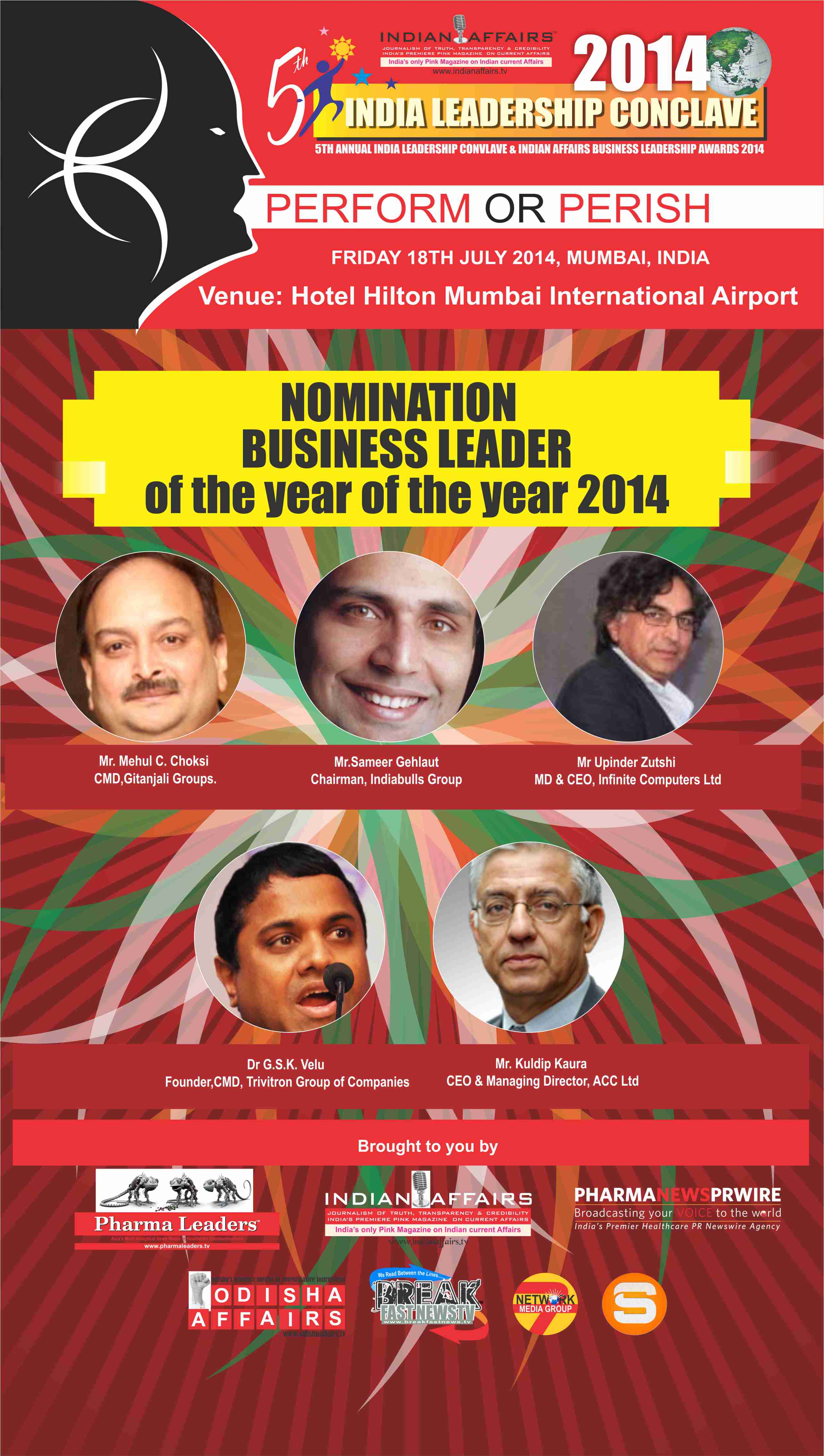
Upinder Zutshi of Infinite, Mehul C. Choksi of Gitanjali Group, Sameer Gehlaut of Indiabulls, Dr G.S.K. Velu of Trivitron Group & Kuldip Kaura of ACC are in race for coveted Business Leader of the year 2014.

Upinder Zutshi of Infinite, Mehul C. Choksi of Gitanjali Group, Sameer Gehlaut of Indiabulls, Dr G.S.K. Velu of Trivitron Group & Kuldip Kaura of ACC are in race for coveted Business Leader of the year 2014.
 Business Leader of the year


The race for the prestigious & coveted Business Leader of the year 2014 at 5th Annual India Leadership Conclave & Indian Affairs Business Leadership Awards 2014 has intensified with five big names from software to Diamond, Healthcare to Cements are open to public for voting. India Leadership Conclave & Indian Affairs Business Leadership Awards 2014 will be held in Mumbai on Friday, 18th July 2014 at Hotel Hilton Mumbai International Airport, Mumbai, India & will be running on a theme Progress or Perish.The Nominees for the Business Leader of the year 2014 & their brief synopsis are listed below.
Mr. Mehul C. Choksi, CMD,Gitanjali Gems Ltd. ( Code 01)
Mr. Mehul C. Choksi has been the Managing Director of Gitanjali Gems Ltd. since August 1, 2007. Mr. Choksi serves as the Chairman and Managing Director of Gitanjali Exports Corporation Ltd. He serves as the Managing Director of Gili India Limited and Gitanjali Trading corporation. He serves as the Chairman of Gitanjali Jewellery Retail Pvt. Ltd., Gitanjali Group of Brightest Circle Jewellery Pvt. Limited, Gitanjali Gems Ltd. and Asmi Jewellery India Private Limited. He serves as a Director of Gitanjali Exports Corporation Ltd., Gili India Limited, MMTC Gitanjali Private Limited, Gitanjali Brands Limited and Modali Gems Pvt. Ltd. He served as a Director of Verite Co., Ltd. He is a commerce graduate.

Mr.Sameer Gehlaut, Chairman, Indiabulls Group. ( Code 02)
Mr. Sameer Gehlaut serves as the Chairman and Chief Executive Officer of Indiabulls Group at Indiabulls Credit Services Ltd. Mr. Gehlaut is a Co-Founder of Indiabulls Securities Limited. He is the Founder of Indiabulls Housing Finance Limited and Indiabulls Power Limited. He is also a Co-Founder of the Indiabulls group of companies engaged in the businesses of real estate, infrastructure, financial services and power sector. He is the Founder of Indiabulls Financial Services Ltd. He served as the Chief Executive Officer of Indiabulls Financial Services Ltd. He was one of the three engineers selected by Halliburton to work for its International services business in the year 1995 and he worked in many countries during his tenure there. He is a Co-Founder of Indiabulls Real Estate Limited and serves as its Chairman. Mr. Gehlaut has been the Chairman of Indiabulls Housing Finance Limited and has been its Executive Director since March 19, 2013. He has been the Chairman and Non-Independent and Non-Executive Director of Indiabulls Power Limited since September 1, 2008. He serves as the Executive Chairman of Indiabulls Financial Services Ltd. ( IBFSL). He serves as the Chairman of Indiabulls Infrastructure and Power Limited and serves as its Non-Executive Director. He served as the Non-Executive Chairman of Indiabulls Retail Services Ltd.(a/k/a Store One Retail India Ltd.) from January 2, 2008 to August 2008. He has been a Non-Executive Director of Dev Property Development plc since January 2007. He has been an Executive Director for Indiabulls Financial Services Ltd. since August 1, 2005. He has been a Non Executive Director of Indiabulls Property Management Trustee Pte. Ltd., the Manager of Indiabulls Properties Investment Trust since January 23, 2008. He serves as a Director of Piramyd Retail Limited. He served as Director of Indiabulls Retail Services Ltd. from January 2, 2008 to August 22, 2008 and Indiabulls Securities Limited from June 26, 1999 to April 1, 2004. Mr. Gehlaut holds Degree in Mechanical Engineering from Indian Institute of Technology, Delhi in 1995.

Mr Upinder Zutshi, MD & CEO, Infinite Computers Ltd. ( Code 03)
Mr. Upinder Zutshi serves as the Chief Executive Officer of Infinite Computer Solutions, Inc. Mr. Zutshi serves as Chief Executive Officer of Infinite Computer Solutions (India) Ltd and has been its a Managing Director since April 2008. Mr. Zutshi set up the offshore operations of Infinite in India. He oversees operations, business development, strategic alliance and partnerships for Infinite. He holds multiple responsibilities within INFINITE managing operations in India and Singapore, mergers, acquisitions and strategic alliances, corporate communications and investor relations. He has successfully led Infinite’s transformation, growth and acquisition strategies, cementing Infinite’s position as a leading global IT services provider. His leadership is evident in the progressive work environment at Infinite designed to has aboard the most qualified and experienced people, foster loyalty and maximize productivity. A hands-on leader, he works closely with Infinite’s clients to execute large IT projects. He provides leadership, vision, direction, strategy and accountability for the various operations of the organization. He served as Chief Operating Officer of Infinite Computer Solutions (India) Ltd. until May 3, 2010. Prior to joining Infinite, Mr. Zutshi served as President of a software services company in the US, which he set up for the Indian parent company Prior to that, he served as international business head of a software solutions and consulting firm, of which he was also a co-founder. In his formative years he has worked extensively in the US and Asia Pac markets, with reputed companies holding key positions in marketing, strategic planning, and new business development. He started his career with CMC Ltd., where he held various positions in sales, marketing and project management for eight years. Mr. Zutshi is a veteran with over 20 years of IT industry experience, he has impressive credentials in the areas of operations, sales, marketing and strategic alliances. He has credible experience in building early stage companies, setting up start-up ventures and nurturing them to heights. He serves as a Director of Infinite Infosoft Services Pvt Ltd. He has been Director of Infinite Computer Solutions (India) Ltd since January 2006. Mr. Zutshi holds a Bachelor of Engineering (Honours) from the Birla Institute of Technology & Science, Pilani, Rajasthan.
Dr G.S.K. Velu, Founder,CMD, Trivitron Group of Companies. ( Code 04)

A Bachelor’s degree in Pharmacy from the Birla Institute of Technology and Science (BITS), Pilani, MBA from Loyola Institute of Business Administration and a Doctorate from IBAM, Kolkata he worked with different global organizations gaining experience in medical technology. In 1997, Trivitron was founded by Dr.Velu and tied up with several world leaders in medical technology to cater to over 20 medical specialties across India. He also established the Trivitron Medical Technology Park, South Asia’s first state-of-the-art medical technology manufacturing facility and the Trivitron Innovation Center, a center of excellence for biomedical research & development and design at IIT Madras.A visionary, Dr. Velu changed the diagnostics field from a highly fragmented industry that served as purely backhand function, into one that plays a leading role in healthcare today. His efforts united leading diagnostics laboratories across the country under the Metropolis banner to set the highest standards of service.His latest venture Medfort is a chain of single specialty ambulatory care hospitals across the country that will soon link some of the nation’s best doctors and technicians with cutting edge technology and international accreditation ensuring that patients get the very best care while continually setting the bar higher in terms of consistent healthcare delivery.
Mr. Kuldip Kaura, CEO & Managing Director, ACC Ltd. ( Code 05)
Mr. Kuldip Kumar Kaura has been the Managing Director and Chief Executive Officer of ACC Limited since August 13, 2010. Mr. Kaura serves as an Adviser of Integra India Group Company Ltd. (alternate name, Integra Hindustan Controls Ltd.). Mr. Kaura serves as an Advisor to Vedanta Resources Plc. He served as the Chief Executive Officer of Konkola Copper Mines PLC until November 2008. He served as the Chief Executive Officer of Vedanta Resources PLC UK from March 23, 2005 to September 30, 2008. He served as the Chief Executive Officer of Sterlite Industries India Ltd. from September 2005 to October 1, 2008 and as its Managing Director from October 20, 2004 to October 1, 2008. He joined Sterlite in 2002. Mr. Kaura served as the Managing Director of Hindustan ZInc. Limited from April 11, 2002 to March 2004 and as Chief Operating Officer of Vedanta Resources PLC UK from December 2003 to March 2005. He has held various positions in operations and business management for 18 years at ABB India. Mr. Kaura served as the Managing Director and Country Manager of ABB Ltd. (formerly Asea Brown Boveri Ltd.) from 1998 to 2002. He served as Deputy Chairman of Konkola Copper Mines (KCM). He has been an Independent & Non-Executive Director of Sesa Goa Ltd. since October 30, 2007. He has been an Executive Director of ACC Limited since August 5, 2010 and Acc Concrete Limited since October 19, 2010. He serves as a Director of Thalanga Copper Mines Pty. Mr. Kaura served as a Director of Regen Powertech Private Limited. He served as a Director of Copper Mines of Tasmania Pty Limited and Thalanga Copper Mines Pty. He served as a Director of ACC Limited from October 2009 to August 5, 2010. He served as a Director of Hindustan Zinc. Limited. since April 11, 2002. Mr. Kaura served as an Executive Director of Sterlite Industries India Ltd. from September 2005 to October 1, 2008. He served as a Director of Konkola Copper Mines PLC, Vedanta Alumina Limited and Vedanta Resources Plc. He served as a Member of directors of ABB India since 1996 and Sterlite Energy Ltd. from November 5, 2007 to October 5, 2009. He has served as member of National Council of Confederation of Indian Industries. Mr. Kaura received B.E. (Honours) in Mechanical Engineering from Birla Institute of Technology & Science, Pilani in 1968 and an Executive education at London Business School & Sweedish Institute of Management Stockholm, Sweden.
About India Leadership Conclave & Indian Affairs Business Leadership Awards 2014
  1. India Leadership Conclave & Indian Affairs Business Leadership Awards are the flagship leadership venture of the illustrious Network7 Media Group  global leadership platform
  2. This Event is held annually in India & is the much sought after event in mainstream India.
  3. Indian Affairs Indian of the Year Awards has been introduced by the jury in 2014 to give highest recognition to the organizations/individuals in social service, sports, business leadership, healthcare, politics & public service
  4. Instituted & conceptualized in the year 2009, the event is rated by the analysts, experts & leaders from different disciplines as the most credible & prestigious title in recent history.
  5. India Leadership Conclave is an effective platform for exchange of ideas, thoughts, networking with business leaders & getting a deep insight from the eminent panel of Speakers.
  6. Widely perceived by the industry Leaders, India Leadership Conclave Platform is attended by top leaders of the country & raise burning topics of tremendous significance.
  7. More than 1000 Delegates have attended the conclave in last four editions & has been richly rewarded intellectually.
  8. More than 300 successful companies & entrepreneurs has been recognized, felicitated & honored at the India Leadership Conclave platform. Fortune 500 companies like Reliance, Tata, Videocon, Fortis Healthcare, Croma Retail, Infosys, Mindtree etc are among the companies in ILC Library.
  9. Iconic & Legendary figures like late Yash Chopra, Rajiv Gandhi & current stalwarts like Ratan Tata, Mukesh Ambani, Rani Mukerjee, Anushka Sharma, Priyanka Chopra, Udaya Kotak etc are few names from the juries voting category.
…………………………………………………………………………………………………….
For Registration, Please get in touch with our Registration Desk :Conclave Secretariat, Network 7 Media Group, Unit No. 53, 2nd Floor, Aditya Industrial, Estate, CTS No. 1068 – C, Plot No.444 ( P ), Devrukhkar Wadi, Chincholi Bunder Road, Malad ( W ), Mumbai – 400 064. Phone: + 91 22 4248 1234 / 4248 1235 Email : sneha@dreamzactivations.com   , anish@dreamzactivations.com

Tuesday, June 3, 2014

Care Hospital Chief & Noted Cardiologist Dr. Somaraju Bhupathiraju to receive the prestigious “India’s Most Admired Surgeon 2014” at Indian Affairs 5th Annual India Leadership Conclave 2014

Care Hospital Chief & Noted Cardiologist Dr. Somaraju Bhupathiraju to receive the prestigious “India’s Most Admired Surgeon 2014” at Indian Affairs 5th Annual India Leadership Conclave 2014
 Dr. B Somaraju - India's Most Admired Surgeon
Noted Cardiologist & the architect of Care Hospitals Dr. Somaraju Bhupathiraju has been selected by the juries of the Network 7 Media Group to receive the coveted India’s Most Admired Surgeon 2014 at the historic 5th Annual India Leadership Conclave & Indian Affairs Business Leadership Awards 2014 ( www.ilc2014.in ). In a statement released to media from the Network 7 Media Group(www.network7mediagroup.in )
Care Hospitals draws its life-blood from the eminent personalities like Padmashri. Dr. B. Somaraju who has spearheaded this movement called ‘CARE’. Prof. B. Soma Raju, Cardiologist from Hyderabad has been providing dedicated service to the people for over 30 years as Cardiologist, Researcher, Teacher and Philanthropist.
In a communication to Network 7 Media Group Chairman & Editor-In-Chief Mr Satya Brahma, the ace cardiologist Dr Somaraju said " I feel humbled to receive this prestigious recognition & look forward to serving the humanity as long as i can"
 He has been involved in various research projects during the last 20 years individually, in collaboration with American Universities and the Defense Scientific Laboratories. The last association culminated in the development of India’s first Coronary Stent, which has been named the Kalam Raju Stent after Professor A.P.J Kalam and Dr. Raju. This stent was first implanted in December 1996. The development of the stent resulted in reducing the cost of stents in the country and brought it within the reach of the people. In October 1998 the second research product of Dr. Raju’s endeavor, India’s first Coronary Balloon Catheter was released. Dr. Raju and his team are working on various medical devices which are used in Interventional Cardiology with the aim of having an Indian alternative for most devices, reducing the cost and making treatment affordable.
Born on 25 September, 1948, Dr Raju was born in to an agriculturist family. He did his MBBS and MD from Guntur Medical College, DM Cardiology from PGIMER, Chandigarh and PhD (HonCausa) from JNTU, Hyderabad. He worked as a Registrar in Endocrinology and Internal Medicine, PGIMER and Chandigarh and Registrar in Cardiology, PGIMER, Chandigarh,
Dr Somaraju and his team set up the Department of Cardiology at the charitable Sri Sathya Sai Institute of Higher Medical Sciences, Puttaparthi and provided free professional services from 1991 to 1994. He had participated in randomised study of balloon mitral valvuloplasty Vs Surgical Closed Mitral Commissurotomy - Immediate and long-term results, Randomised Study of Balloon Mitral Valvuloplasty Vs Surgical Open Mitral Valvotomy - Immediate and long-term results. Dietary correlation's with lipid profiles in patients with and without Coronary Artery Disease (CAD) in Indian population, Phase-III Clinical Investigation of EB Sideri's Button device for closure of arterial septal defects and patent ductus arteriosus, indigenous development of cardiovascular catheters- diagnostic catheters, coronary angioplasty balloon, valvuloplasty balloon catheters.
He has been involved in indigenous development of external and implantable pacemakers in collaboration with Research Centre Imarat (RCI), Hyderabad, development of indigenous coronary stent in association with Defence Metallurgical Research Laboratory Centre (DMRL), Hyderabad, development of PC-based cardiac stress test system in association with Defence Bio-Engineering and Electromedical Laboratory (DEBEL), Bangalore.He has conducted the first Percutaneous Transluminal Coronary Angioplasty (PTCA) in India on April 17, 1985. He has developed India's first coronary stent (Kalam-Raju Stent) and implanted on December 22, 1996 at Mediciti Hospitals. This contributed to significant reduction of the cost of stents, as a whole, in India.He has contributed to the introduction of India's first Coronary Balloon Care Ultima on October 29, 1998. He also has written a book called 'clinical methods in cardiology.'
Dr Somaraju plans to scale up its tertiary care model by setting up new state-of-art hospitals in newer territories. His vision for the next decade is 10,000 beds. The Group may also consider going public.

For Registration, Please get in touch with our Registration Desk
Conclave Secretariat,
Network 7 Media Group, Unit No. 53,
2nd Floor, Aditya Industrial, Estate,
CTS No. 1068 – C, Plot No.444 ( P ),
Devrukhkar Wadi,
Chincholi Bunder Road, Malad ( W ),
Mumbai – 400 064.
Phone: + 91 22 4248 1234 / 4248 1235