Thursday, June 14, 2012

Jagan’s Pharma Connections : Deadly South!


Jagan’s Pharma Connections : Deadly South!
Aurobindo Pharma, Hetero Drugs, Ramky Pharma , Trident Life Sciences & Matrix Laboratories are under CBI scanner. Healthcare Industry stunned at South volcano.
Satya Brahma
Editor-In-Chief, Pharmaleaders Magazine

Andhra Pradesh is historically known to be a tumultuous state with a notorious past of brinkmanship, nepotism, political back-stabbing, and corruption & high voltage dramatic shameful incidences. Chandrababu Naidu, the Ex CM of AP backstabbed NTR & catapulted to power, Ram lingam Raju, the founder of Satyam hit the headlines for wrong reasons & now Jagan Mohan reddy, the maverick son of Late Dr Y S R Reddy is paying the price of building an empire based on dubious steals & is counting his days in the prison amidst high security, almost like Z Plus. CBI is grilling the media magnet cum politician, the Chief of YSR Congress, Jagan Mohan Reddy & certainly Hyderabad is on fire. With these south connections, now we are seeing many healthcare companies getting directly or indirectly have been indulged in Jagan’s vast empire seeking favours, getting unjustified market values for the land , alleged partnership & many more startling stories that has stunned the country writes Satya Brahma, Editor-In-Chief of Pharmaleaders ( www.pharmaleaders.co.in ). “India is a land of billion opportunities; it is also a land of endless possibilities & since Politics is art of possible, all these connections sneak of a deep rooted connections as CBI has filed a charge sheet saying Jagan allegedly received Rs 1,172 crore as bribes from investors from wide spectrum of business communities in south including healthcare players named above”..
What is wrong in getting political favours in return with huge compliments in donating a hefty amount to the politicians, when laws are broken to please a select few in healthcare business, when the similar exercises are seen in other sectors across the globe? In fact, if we look & scan all business empires, we will find strong political connections says Satya while investigating the connections of companies like Aurobindo Pharma, Hetero Drugs, Ramky Pharma & Trident Life Sciences, Matrix Laboratories,  presently questioned by CBI in connection with unlawful dubious connections. In Fact, Nimmagadda Prasad, better known as Matrix Prasad is arrested & still in Jail while others have been out on bail.
In fact if we track our history, the story goes back to the economic liberalization era post 1999 when major reforms were charted, the than CM of AP, Chandrababu Naidu was also allegedly involved in getting business community & striking a partnership, cut deals to favour government allocations. The latest buzz in healthcare companies who were named by CBI in their chargesheet, to my mind, are not surprising, given the massive nepotism, found in CBI report, of a total of 72 Companies, being framed.
The Company in news are very prominent & successful in global healthcare business, while Aurobindo pharma  is big time in semi synthetic penicillin market worldwide & is a global leader while Hetero Drugs is a global player in Bulk Drugs. While Ramky Pharma is a knowledge pharma city & Trident Life Science is a CRO, an extended arm of Aurobindo Pharma. All the four outfits have been in public eye ever since CBI grilled the owners of these companies alleged to have been in a favorable entry due to Jagan connections.
Lets have a close look of these Five Companies who are alleged to have been favored by Jagan.
Jagan received Rs 1,172 crore as bribes from investors: CBI
The Central Bureau of Investigation (CBI) has disclosed that Y S Jaganmohan Reddy, popularly known as Jagan, accepted Rs 1,172 crore from various investors as bribe and in turn helped them get favours from the state government. The favours are mainly land, mining leases and licences for new industries. Jagan, Member of Parliament from Kadapa and late chief minister Y S Rajasekhara Reddy’s son, was arrested by the investigating agency on May 27 in connection with a disproportionate assets case. A CBI special court in Hyderabad on May 28 remanded him to judicial custody for 14 days. He will remain in the Chanchalguda Central Prison till June 11. According to CBI, Jagan, president of the YSR Congress Party, amassed huge wealth during 2004-2009, when his father was the chief minister. Jagan’s declared assets were Rs 1.7 crore in 2004. It shot up to Rs 77 crore in 2009 and then to a whopping Rs 356 crore in 2011. As per the investigating agency, Jagan misused his father’s office to grant favours to industries and individuals. In turn, they invested in Jagan’s businesses including Sandur Power Company, Janani Infrastructure and Jagati Publications which brings out Sakshi, a Telugu daily.
The investigation into Jagan’s wealth by CBI started in August last year following a direction by the Andhra Pradesh High Court. The court was acting on a petition filed by a ruling Congress member of the legislative assembly P Shankar Rao. CBI in its First Information Report (FIR) has named 73 firms and individuals in connection with the case, apart from Jagan as accused number one and his financial advisor V Vijay Sai Reddy as accused number two. A few industries like Aurobindo Pharma, Hetero Drugs, Trident Life Sciences and Ramky Pharma India Limited, Penna Group, India Cements and Dalmia Cements have also figured in the chargesheets and the remand report submitted by the investigating agency in the court. The individuals named in the chargesheets include industrialist Nimmagadda Prasad, promoter of Vodarevu and Nizampatnam Port and Industrial Corridor (Vanpic), Y Vijaya Lakshmi Prasad, general manager of Andhra Pradesh Industrial Infrastructure Corporation (APIIC) and senior IAS officer B P Acharya and G Venkataram Reddy, a former vice-chairman of Visakhapatnam Urban Development Authority (VUDA). According to CBI, in many instances the government–owned APIIC acquired cultivable land from farmers for developing industrial parks and special economic zones, and then gave it to investors, a quid pro quo for their investments in Jagan’s company. For instance, APIIC gave 5,260 hectare (ha) in Guntur and Prakasam districts to Nimmagadda Prasad for Vanpic project by doctoring the terms of the concession agreement. Prasad had invested Rs 854 crore into firms owned by Jagan through his companies Alpha Villas and Gilchrist Investments. Besides Vanpic, he was also given several concessions under the Stamps and Registration Act, alleges CBI. Farmers who lost their land-holdings to Vanpic are still protesting against forcible acquisition of land. Prasad was arreasted by CBI on May 15.
Aurobindo and Hetero groups were allotted more than 60 ha on lease at Rs 17.5 lakh a ha in the green industrial park of APIIC at Jadcherla in Mahbubnagar without proper assessment of requirement of land, says CBI.  The transaction resulted in a loss of Rs 12.26 crore to APIIC as the rate fixed by the Price Fixation Committee of the government ranged from Rs 37.5 lakh-50 lakh a ha. Around 12 ha of land at the Export Promotion Industrial Park at Pashamylaram in Medak were transferred to Trident Life Sciences Limited by falsely representing that it was a 100 per cent subsidiary of Aurobindo Pharma. Otherwise, the deal was not allowed as per APIIC rules. In another instance, Ayodhya Rami Reddy, promoter of Ramky Pharma , which is implementing a pharma city over 971 ha in Visakhapatnam, wrongfully gained around 370 ha, and made a gain of Rs 133 crore from selling this plot.  Ramky had invested Rs 10 crore in Jagati Publications as a quid pro quo for the benefits it secured.

Monday, June 11, 2012

Aanjaneya Lifecare sales jumps by 50% to Rs.480 cr

Aanjaneya Lifecare has posted strong top line growth during the year ended March 2012 and its net sales increased by 50 per cent to Rs.479.96 crore from Rs.320.26 crore in the previous year. Its net profit improved by 13.9 per cent to Rs.41.03 crore from Rs.36.01 crore. After taking into consideration the rise in equity capital, its earnings per share worked out to Rs.34.42 as compared to Rs.52 in the previous year.

Its EBDITA went up to Rs.107.76 crore from Rs.70.85 crore, a significant growth of 52.1 per cent. The company recommended equity dividend of 20 per cent for the year 2011-12. The company has manufacturing and marketing capabilities in APIs with focus on anti-malarial, CRAMS and finished dosage forms catering to various therapeutic segments.

Dr Kannan Vishwanath, managing director, said, “It has been a very promising year for the company, one in which we could achieve our goals set towards customer satisfaction, quality standards and of course shareholder value. We are on the path of expansion, with recent acquisition of Apex Drugs & Intermediates Ltd giving us an entry in Hyderabad market.”

The company raised about Rs.117 crore from its IPO and the funds are being used to built new capacities along with the refurbishing of R&D centre and CRAMS centre. The new facilities being created as part of CAPEX will comply with the latest European & US guidelines. With new capacities to be added in next 6 to 9 months the company will be expanding operations in emerging markets of South East Asia, Africa and South & Central America and its domestic operations in branded generics segment.

The company's equity capital increased to Rs.13.89 crore during 2011-12 from Rs.7.58 crore in the previous year as the company issued 13,10,484 shares of Rs.10 each at premium of Rs.486 per share to other than promoter on a preferential basis. Currently, the Aanjaneya scrip is moving aroundRs.525 on BSE.

Saturday, June 9, 2012

Indian economy to grow at slower pace of 6.7 per cent in 2012: UN

The UN has cut down its growth forecast for India for the year 2012, predicting a 6.7 per cent growth rate rather than a 7.7 per cent rise predicted earlier, while listing euro debt crisis as the biggest threat to world economy.

In its World Economic Situation and Prospects mid-year update, the UN said the global economic situation continues to be challenging and global growth will likely remain tepid in 2012 following a marked slowdown in 2011.

The global economy is projected to grow by 2.5 per cent in 2012 and 3.1 per cent in 2013, following a growth of 2.7 per cent in 2011, a slight downward revision from previous forecasts, report said.

GDP growth dips to 5.3% in Q4 

"An escalation of the euro area debt crisis could result in severe turmoil in financial markets and a sharp rise in global risk aversion, leading to a further weakening of global growth," the UN said in the report.

Most regions of the world would also be expanding at a pace below potential.

Economic growth in South Asia is projected to be moderate to 5.6 per cent in 2012, down from 6.1 per cent in 2011 as the region continues to face significant regional and global headwinds.

India to grow at 7.7% in 2013: OECD

India's economy is forecast to expand by 6.7 per cent in 2012, after growing by 7.1 per cent in 2011, it said.

In January this year, the UN had pegged India's economic growth rate at 7.7 per cent for 2012 and 7.9 per cent in 2013 in its World Economic Situation and Prospects.

Weak demand in developed countries and a slowing Chinese economy are likely to weigh on economic growth in East Asia.

Average regional growth is projected to slow from 7.1 per cent in 2011 to 6.5 per cent in 2012. Growth in China is forecast to slow from 9.2 per cent in 2011 to 8.3 per cent in 2012.

Indian Economy at its Best!


Equitymaster presents a roundup on the performance of the key Indian and global indices and key corporate and economic news during the week ended June 08, 2012.

Barring China, Hong Kong and Singapore the world equity markets closed the week on a positive note with healthy gains. The US stock markets were up 3.6% during the week. This was the best ever week for the US stock markets in 2012. As per the Commerce department, the US wholesale stock piles grew by 0.6% in April 2012. This was double of what was reported in March. This indicates increased production and resulting demand for the factory output. Markets reacted positively to it as consensus had priced in a lower growth.
The Indian equity markets too ended the week with strong gains. The markets were up by 4.7%, having registered the best weekly gains of 2012. Hopes of global stimulus and expectations of rate cut spooked markets. Further, declining crude oil prices and government’s commitment to help kick start the stalled infrastructure projects buoyed the markets.
Amongst the other world markets, China was down 3.9% during the week. This was despite a rate cut by the Chinese central bank. Apart from China, both Honk Kong and Singapore were down 0.3% each. However, France and UK were up by 3.4% and 3.3% respectively.
N/A
Source: Yahoo Finance
All the sectoral indices closed the week in the green except for consumer durables. The capital goods and banking stocks were the biggest gainers having registered gains of 10.9% and 7.8% respectively during the week. Rate cut hopes fuelled rally in these stocks. Realty and power stocks were up by 6.3% and 6.1% respectively as well. However, consumer durable pack was the lone loser having lost 2% during the week.
N/A
Source: BSE
Let us now take a look at key sector news during the week. After a gap of two months of single digit growth, cement sales volumes in India are expected to reach double digit levels during the month of May 2012. As per a leading business daily, this is expected to be largely driven by robust sales from the two cement majors UltraTech Cement and Ambuja Cements. It may be noted that these two companies along with ACC Ltd control nearly one-third of the cement market in India. While the latest GDP (Gross Domestic Product) data may not be very encouraging, especially for the quarter ended March 2012, it is believed that the strong dispatches of the commodity (especially during the pre-monsoon season) have given the industry such an expectation of double digit growth. For instance, Ambuja Cements reported an almost 12% YoY increase in cement volumes in May this year. UltraTech Cement is believed to have reported a growth of 10.6%. During FY12, the cement sector reported a growth of about 6.5%.
For the full year FY13, the industry is expected to grow by about 8 to 9%. Historically the sector has grown at a pace of about 1.5 times the GDP growth of the country. Going forward, the growth in the sector is expected to remain firm on the back of higher demand emanating from the infrastructure and construction sector.
Now let us take a look at a few corporate events that unfolded during the week. Aurobindo Pharma had a forgettable FY12 wherein issues with the US FDA (for plants unit III and unit VI), lower dossier income and anti-retroviral sales impacted overall performance. However, there has been some relief for the company. The FDA has started approving drugs from Aurobindo Pharma's unit III and is also expected to audit unit VI in July-September. Unit VI especially is a key facility manufacturing cephalosporins (anti-infectives) in the injectables space. It must be noted that the USFDA had inspected the company's unit III and unit VI, both located in Andhra Pradesh, in 2010 and found significant violations of its goods manufacturing norms. The regulator thus issued a warning letter to the company along with an import alert in 2011. Given that unit III is operating at optimum capacity, plans are in place to shift some production to unit VII. Having said that, once the company receives the green signal for unit VI, it will result in a ramp up in performance. From its unit VI, Aurobindo had made applications for a total of 24 drugs in the US.
As per a leading financial daily, Hero MotoCorp has chalked out investment plans to the tune of Rs 25.75 bn. The country's largest two-wheeler maker in terms of volumes will set up two manufacturing units in Gujarat and Rajasthan and also a new research & development (R&D) centre by the financial year 2013-14 (FY14). The first plant would come up at Neemrana (Rajasthan) by the first quarter of 2013-14 (1QFY14). With an investment of Rs 4 bn, this plant will have an initial installed capacity of 7.5 lakh units per annum. The proposed plant in Gujarat will entail an investment of about Rs 11 bn and will have an installed capacity of 1.2 million units per annum by the second quarter of 2013-14 (2QFY14). These investments will take the total installed capacity of Hero MotoCorp from the current 7 million units to 9 million units by FY14. In addition, the integrated R&D centre which is set to come up on a 250-acre plot near Jaipur will entail an investment of Rs 4 bn.
As per a leading financial daily, the Fuel Supply Agreement (FSA) to be signed by Coal India Ltd (CIL) is witnessing a wave of disapproval by power producers. In March 2012, the Prime Minister's Office had asked CIL to sign FSA with power generation companies at a minimum supply of 80% of the total coal requirement. CIL had informed the power producers that only 60% of the coal demand can be met presently and the supply will be scaled up to 80% in the coming years. But the Power Ministry has insisted on a minimum supply level of 65% if CIL is unable to meet the mandated commitment of 80%. Another bone of contention is the penalty clause. CIL has suggested a penalty of 0.01% for failure in the timely delivery of fuel but wants the penalty to be imposed only after three years of signing the pact. Many power producers, including National Thermal Power Corporation (NTPC) do not agree with the clauses introduced in FSAs and have refused to sign supply agreements with CIL. Reportedly, 14 power utilities have inked FSAs with CIL so far.
Movers and shakers during the week
N/A
In some other important economic news, United Nations (UN) has cut the GDP growth forecast of India for 2012. It now expects the country to grow at 6.7% as against the 7.7% growth predicted earlier. Amidst the current economic situation, the world economy is also expected to register a modest growth of 2.5% in 2012 and 3.1% in 2013. Thus, as per UN, the overall growth prospects over the next year appear to be dim.
The Reserve Bank of India (RBI) is likely to announce its credit policy on June 18. While the market players are hoping for a rate cut it would be interesting to see if RBI obliges this time around considering the inflationary pressures prevailing in the economy. However, it may be noted that a drop in crude oil prices has provided some headroom to the RBI for rate cut.

Thursday, May 31, 2012

Unpleasant Monsoon in Politics & Unstable Economic Scenario Grapple India’s Growth Story


Unpleasant Monsoon in Politics & Unstable Economic Scenario Grapple India’s Growth Story
LK Advani Fumes at Nitin Gadakari, Naveen Patnaik feels uncomfortable, The GDP data at a staggering 5.3 percent cripple Political-Economic Growth
Satya Brahma

BJP patriarch L K Advani today is a lonely man & feels ignored by ambitious second generation maverick politicians & surely missing his long-time colleague Atal Bihari Vajpaye who is ill & bede-ridden.  Many see the recent remarks by Advani in his blog slamming the RSS influenced BJP President Nitin Gadkari as the reincarnation of his image in an desparate attempt to exercise his monopoly in the faction-ridden Parivar who termed the present feel in the party is NOT UPBEAT.
In politics, we all know ambition rules over values & BJP has adapted the present state of affairs as the most unfortunate given Modi’s status in post Gordha, Yeddurappa’s political ambitions, Raje Scindhi’s revolt in Rajasthan are ample indications to prove that all is not well in the party.
Meanwhile the Nifty is trading above the 4,900. However, market sentiment continues to remain weak after the latest GDP data showed India’s growth slipping to 5.3 percent, lowest since a decade.
The improvement in the markets could be attributed to the European stocks which opened higher as the markets were looking to stabilize after a tumultuous trading session the prior day, amid concerns about Spain.
Surely BJP’s uneasiness will never be an asset for Congress who is targeted by Anna & the original reformer of Indian Economy Dr Singh is not spared.
Issues are complex, situations are worse, the road ahead looks dim if not black.
The Author is Editor-In-Chief of Indian Affairs & a passionate advocate of free Press.

Saturday, May 19, 2012

Eli Lilly Looks Like A Short


Observe, Orientate, Decide and then Act
If one is to know truly one must see truly. The power and importance of observation cannot be overstated. The stock market is not an environment that allows the application of the scientific method. We cannot subject a control group to a certain stimuli and draw conclusions from the findings. It is more analogous to astronomy where orbitals and complex vector space is quantified by understanding position and momentum and attributing values to each.
An inherent problem with observation is that we tend to perceive what we expect to perceive and our perceptions resist change even in the face of new and better data. In addition, conclusions drawn from a small body of consistent data engenders more confidence than those drawn from a larger body of less consistent data. It is a critical junction where judgment becomes more important than knowledge. Once you evaluate your observations you must orientate your exposure to the long and/or short side of the market and then decisively act.
Based on the foregoing, these are my views and observations:
The Trade - I suspect that (LLY) is a short at $41.50. I would only establish ¼ of the position at $41.50 and the remaining ¾ at $44.00 with a stop out at $46.25. I would never post my stop loss. It is too easy for the Designated Market Maker to cash investors out by raising the price above the stop out and move the price right back down again. Remember the "Flash Crash"? This is a short-term trade and nothing more. I would be looking to cover at $38.00. This is based on the facts that we know at the present time.
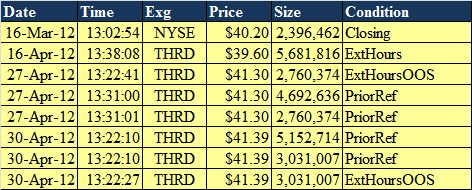
I believe Insiders have been distributing and selling short. It is in the process of forming a double top. In addition, it is currently at the higher levels of a trading range and this is occurring to the accompaniment of an increase in big block activity and heavy aggregate volume (300% greater than the 3-month average). When you witness this type of activity you can be fairly certain (but not positive) that insiders are liquidating positions and selling short.
I believe that the Designated Market Maker in this issue has depleted his inventory and will drop the price in order to cover his short positions, replenish his inventory and accumulate from the selling which ensues.
(click to enlarge)
Although the blocks below are controlling the pattern they are not large enough to expect a long-term trend reversal. They are more indicative of a reversal in a trading range. In this case a sideways channel pattern. They also have occurred at clearly obvious support/resistance levels, which make them all the more significant.
Blocks, which evidence themselves at the reversal of a long-term trend in this issue, should be about 20,000,000 shares or greater or a series of blocks aggregating a position of that magnitude. A pullback to $38.00 to $39.00 is most likely. I might just split the difference for the cover.
That's it for now ...have a nice day.

Eli Lilly Could Sink On Drug Collusion In India


Recent discoveries have placed Eli Lilly (LLY) in the spotlight forcolluding with India's drug regulators.
Eli Lilly, along with other Big Pharma names such as GlaxoSmithKline (GSK) and Novartis (NVS), has been colluding with Indian drug regulators to speed up approval procedures and put drugs on the Indian market that are not yet available or even legal in other countries. Thirteen of the drugs being investigated are not allowed to be sold in United States, Canada, Britain, European Union and Australia. The question of course arises how exactly the companies involved can justify selling such drugs in India. Several other major drug companies and firms have also been implicated. It took an 18-month investigation to reach this conclusion, but it does appear to be true.
What I gather from this information is that there is a lack of adequate supervision in emerging markets in India, where drug companies and other major industries are starting to focus their attention more intensively. The reason for this strong focus is that drug companies like Eli Lilly are feeling the pressure that comes from patent expirations. The only way for the company to maintain a good profit is by focusing on these emerging markets. Because of this sudden "dash" into new markets, the U.S. government has grown suspicious of the activities of drug companies. This led to the investigation under the Foreign Corrupt Practices Act and consequently resulted in the report regarding the activities of Eli Lilly and others.
The report references collusion between drug companies such as Eli Lilly, the Central Drugs Standard Control Organization (CDSCO), and independent medical experts. It is interesting to note that the CDSCO is not accused of wrongdoing outright. None of the officials of the firm have been named. To me, it seems that the blame will rest mostly with the pharmaceutical companies involved, which would threaten Eli Lilly's future. The report focuses instead on the series of procedural failures that have led to the various companies involved being accused of marketing drugs that are not, strictly speaking, safe.
If Eli Lilly is found guilty in this regard, it will mean that its stock should decline significantly. Perhaps the worst effect it will have is that investors will lose faith in the company and its ability to provide them with a reliable stock to back.
Novartis announced its intention to look into the allegations that it colluded with Indian drug regulators. A number of drugs were randomly assessed and in 11 cases, including Novartis' everolimus and aliskiren, it was found that "mandatory" Phase III clinical trials had not been conducted as required. In its defense, Novartis claims that it conducted trials as per one global standard. It stands by the safety and efficacy of its drugs. Regardless of the final outcome, it is clear that companies such as Novartis and Eli Lilly are going to be painted in a very bad light for the next few months.
In other news, Eli Lilly has won a small victory in court. Recently, courts sided with the company in rejecting the idea that companies must pay overtime to their sales force. The plaintiff argued that, as she did not close any sales and as she does not fall under the same heading as administrative exemption, that she should be entitled to overtime. This is at least something positive for the company. If it had lost the suit, it would have become instantly vulnerable to multiple class action cases leveled by sales employees demanding back pay for the many years that they did not receive overtime benefits. Longstanding federal labor law exempts salespeople from overtime requirements. However, this is not the only case of its kind that has recently been made against pharmaceutical companies. If the high court rules against pharmaceutical companies in another case, Eli Lilly -- along with many other players in the market such as Abbott (ABT) and Johnson & Johnson (JNJ) -- will still be significantly affected.
Eli Lilly competitor Pfizer (PFE) has finally decided to give up once and for all on Lipitor. Following an aggressive marketing campaign to make as much money as possible following the expiration of the Lipitor patent, Pfizer has now ceased all marketing efforts related to the drug. The company is now focusing more intensively on the other medications in its pipeline, such as tofacitinib, which the company hopes will soon beapproved by the FDA. At this stage, new drugs are the only way for Pfizer to get back in the game.
Sanofi (SNY) appears to be downsizing as well, although in this case it may be against the company's will. Recently, it announced its intention to close a plant in Newcastle that is likely to leave 450 employees, some of whom have been working at the plant for decades, without jobs. In addition another plant will also be closed, which means that even more employees will lose their jobs. Clearly, the company is in some sort of trouble if so many plants are being shutdown at once.
Last but not least, GlaxoSmithKline made a bid to take over the drug manufacturer Human Genome Sciences (HGSI). The two companies have a long history of cooperation and so it is hoped by GSK at least that the deal can be closed on friendly terms. Glaxo is offering $13 cash per share for the company, a very good deal that Human Genome is unlikely to beat. In fact, no other buyers have stepped forward and it seems that Human Genome, which thus far attempted to hold on Glaxo, may just have to give in and merge with its stronger partner.
Eli Lilly just gotten caught red-handed in this collusion fiasco. Look for it to make some play that will help it avoid long-term consequences from it. Anything less, I'm afraid, could drive the company further down than you'd want it to be.